The Cards
Calling the King uses the full deck: all 54 cards, 22 Taroks and eight cards in every color suit. Nothing is set aside, and the deck holds 70 Card Points in total.
The Preparation
Four players sit around the table, and play runs counter-clockwise. The Forehand sits to the Dealer’s right; the player opposite the Dealer cuts.
Starting with the Forehand, the Dealer deals 6 cards to each player. Then the Dealer lays 6 cards face-down in the middle as the talon: two piles of three cards, each pile one half of the talon. Then the Dealer deals 6 more cards to each player, so each player holds 12 cards. The deal passes to the right after every hand.
 P1
Forehand
P2
cuts
P3
P4
Dealer
The Bidding
The bidding works as taught under Bidding in Core Concepts, on the ladder below. The Forehand bids first, and the bidding runs counter-clockwise. The Forehand may pass at the very start and still bid when the turn comes around the second time; everybody else’s pass is final. Here every seat, the Forehand included, bids higher or passes.
Every bid fits a particular kind of hand. If everybody passes, the Forehand must play a contract: one of the Forehand’s own contracts that open only after everybody has passed (☆ in the table below), or any contract on the ladder except the Blind Solo. The Blind Solo is only available to the Forehand at the very beginning, and it ends the bidding.
The contracts in these rules are a basic set. No two groups play Calling the King exactly alike, and you are meant to build on this set.
| Contract | VP | Leads | Talon |
|---|---|---|---|
| The base contracts | |||
| Piccolo | 2 | Declarer | 0 |
| You play alone against three and must win exactly one trick, no more and no less. | |||
| Beggar Bettler |
4 | Declarer | 0 |
| You play alone against three, and if you win even one trick, you have lost the Beggar. | |||
| No-Trump Farbendreier |
4 | Forehand | half |
| You play alone against three with half the talon, the Taroks play as a plain suit, and you need at least 36 Card Points. | |||
| No-Trump Solo Farbensolo |
8 | Forehand | 0 |
| You play the same contract as No-Trump, without the talon, for double the Victory Points. | |||
| Blind Solo ★ Sechserdreier |
5 | Forehand | all 6 |
| You play alone against three, take all six talon cards into your hand unseen, and need at least 36 Card Points; if you fail, each Defender adds 10 Victory Points. | |||
| Forehand only after everyone passes | |||
| The Call ☆ Rufer |
1 | Forehand | half |
| You call a King, take half the talon, and your side needs at least 36 of the 70 Card Points. | |||
| Dodge Round ☆ Trischaken |
5 | Forehand | drip |
| Everyone plays for themselves and tries to capture as few Card Points as possible; the player with the most Card Points loses, and the other three add 5 Victory Points each. | |||
In the Talon column, half means that the Declarer takes half the talon, all 6 means that the Declarer takes the whole talon, 0 means that the Declarer takes no talon cards, and drip means that one talon card falls onto each of the first six tricks.
★ Only the Forehand may bid this contract, and only as the first bid. ☆ Only the Forehand may play this contract, and only after everyone has passed.
Calling a King
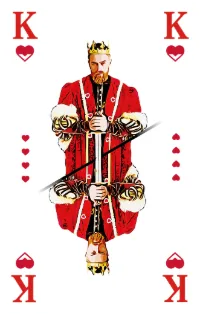
In the Call, the Declarer names a King out loud: “The King of Hearts plays with me!” Whoever holds that King is now the Declarer’s secret Partner, and reveals nothing. The other players learn who the Partner is from the cards that are played.
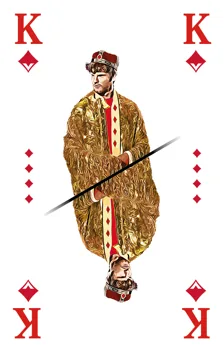
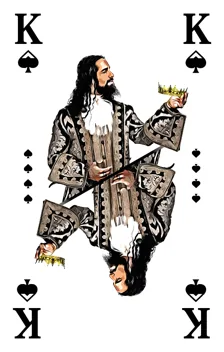
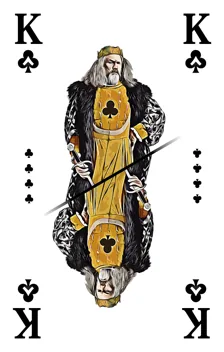
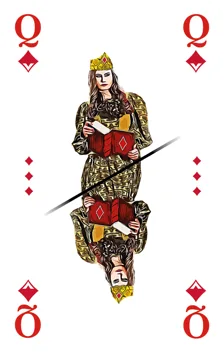
If you hold three Kings yourself, you may call “the fourth King” without naming a suit. If you hold all four, you may call a Queen instead.
The Talon
If the Declarer takes cards from the talon, the exchange happens before the first trick.
The talon. The contract table shows, for each contract, what happens to the talon: half, all 6, 0 or drip.
Half. Both halves of the talon are turned face up for everyone to see. The Declarer takes one half into their hand; the other half goes to the Defenders’ pile and counts for them at the end. The Declarer then discards three cards face down, so the hand is back to twelve.
All 6. The Declarer takes all six talon cards into their hand without looking at them first, then discards six cards face down, so the hand is back to twelve.
The discard. The discarded cards count for the Declarer at the end. The discard may never hold a King or a Trull card. As a rule a Tarok goes down only when no other card can be spared, and it goes down face up for all to see; No-Trump turns this around and asks for Taroks first (see No-Trump below).
0. Nobody looks at the talon until the hand is over, and nothing is discarded. Where Card Points are counted at the end, the talon counts for the Defenders.
Drip. The talon is one stack of six cards. After each of the first six tricks, the top card is turned face up and added to that trick, and it counts with the trick.
The called King in the talon
If the called King lies in the talon, everyone sees it when the talon is turned face up. Then the hand is not played: the cards are shuffled, and the same Dealer deals again. This is the simplified rule; the Expansions give the traditional rule, in which the Declarer may concede or play on alone.
The Contracts
The Call Rufer
In the Call you call a King, take half the talon, and bring your side to at least 36 Card Points. Only the Forehand ever plays it, so here the Forehand is always the Declarer.
Piccolo
This is a negative contract (see The Three Ground Rules in Core Concepts): you play alone against three and must win exactly one trick. For every player, the Pagat may only be played as its owner’s very last Tarok. One rule binds only the Declarer: a Piccolo may not be bid or named with the Skus in hand.
Beggar
This is a negative contract: you play alone against three, and if you win even one trick, you have lost the Beggar. For every player, the Pagat may only be played as its owner’s very last Tarok.
No-Trump and No-Trump Solo Farbendreier, Farbensolo
These are the no-trump contracts (Dreier is the old word for playing alone against three). The Taroks lose their trump power and play as an ordinary fifth suit: nothing trumps anything, and the highest card of the led suit takes the trick, every trick. But the Tarok Rule applies even here: if you are void in the led suit, you must still play a Tarok, although it wins nothing. You may not lead a Tarok while you hold color cards.
In the No-Trump, the Declarer must discard Taroks first, and discards them face down. The Declarer may discard a color card only when they have no Tarok left that may be discarded, and must discard that color card face up. No-Trump takes half the talon; No-Trump Solo takes none of it, for double the Victory Points.
Dodge Round Trischaken
Only the Forehand may play it, and only when the other three players have all passed. Everyone plays for themselves and tries to capture as few Card Points as possible. The Rising Rule is on, there are no bonuses, and the talon goes into the tricks (see “The Talon”, above). After the tricks are done, the player with the most Card Points has lost and the other three each add 5 Victory Points. If two or more players tie for the most Card Points, the tied players lose, and only the others add Victory Points.
Blind Solo Sechserdreier
Only the Forehand may bid the Blind Solo, and only as the Forehand’s first bid. You play alone against three and take all six talon cards (see “The Talon”, above). If you win, you add 5 Victory Points; if you fail, each Defender adds 10 Victory Points.
Should you claim it?
This section helps you decide which contract you can take on with your twelve cards.
Calling the King uses one quick count. It is called the 12-count, after the bar it sets for playing alone.
| Card | Count |
|---|---|
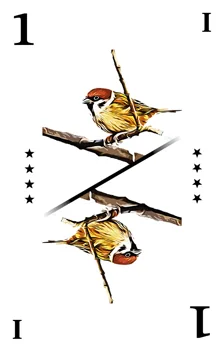
| Taroks, the Pagat included | 1 each |
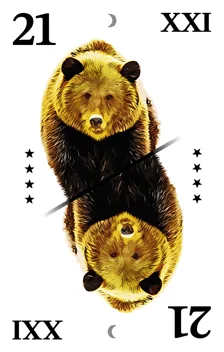
| Big Taroks, the XV and up, the XXI and the Skus included | 2 each, double instead of 1 |
| Kings | 1 each |
| All other cards | none |
Add it all together, and carry that number into the bids below.
| Contract | Claim it when you hold |
|---|---|
| The Call Rufer |
a count of about 8 or 9: several Taroks with a big Tarok, a Trull piece or a King among them. Only the Forehand chooses it, and only after the other three have passed |
| Piccolo | a hand that would match the Beggar but for exactly one card that will win a trick whether you like it or not (a big Tarok with small Taroks below it, or a bare high court); with two such cards you lose the Piccolo |
| Beggar Bettler |
a four-suited hand, or one with no Taroks at all, nothing that could win a trick you don’t want |
| No-Trump Farbendreier |
about 7 sure tricks or 25 Card Points sitting in hand once the Taroks go ordinary |
| No-Trump Solo Farbensolo |
8 sure tricks or 30 Card Points, since no talon is coming to help |
| Dodge Round Trischaken |
a count below what the Call asks for; only the Forehand may choose it, and only after the other three have passed |
| Blind Solo Sechserdreier |
12 or more, counted before the six blind cards arrive, because you do not know what the talon will bring you. Only the Forehand may bid it |
A secret Partner is budgeted at about two tricks, which is why the Call claims on less. The full 12 is the bar for playing alone, not the Call’s.
A lone King usually survives its first suit trick here, and gets trumped only about one time in five: count it as nearly a whole trick.
Bonuses and Announcements
Bonuses count unless the contract says otherwise: the negative contracts score none, and the no-trump contracts score none of the three in the table below. If the contract allows bonuses, each player of the side that earns a bonus adds its silent or its announced value (see Bonuses and Announcements in Core Concepts). If an announced bonus fails, each player of the other side adds the doubled value. Bonuses are scored regardless of who won the contract.
King Ultimo (König Ultimo) is announced by the player who holds the called King, and it is a promise: the called King will be played to the last trick, and the Declarer’s side will take that trick, whether the King wins it or the Declarer’s Tarok does. Apart from playing the called King itself, announcing King Ultimo is the only way the Partner is ever allowed to reveal who they are.
There are more announcements in the Expansions.
| Bonus | What it takes | Victory Points | |
|---|---|---|---|
| Silent | Announced | ||
| Pagat Ultimo Pagat Ultimo |
The Pagat wins the last trick. | +1 | +2 |
| II Ultimo Uhu |
The II wins the second-to-last trick. | +2 | +4 |
| King Ultimo König Ultimo |
The Declarer’s side takes the last trick, and the called King is in it. | +1 | +2 |
Playing the Hand
The Forehand starts the first trick unless the contract says something else. In the negative contracts, the Declarer leads the first trick. These rules play Calling the King without the Fairy Tale Trick.
Scoring the Hand
If the contract scores from the value of the tricks rather than the number of tricks, this is how you count Card Points (see Scoring in Core Concepts). Gather your side’s captured cards, then count in three steps:
- Step one: count the captured cards of your team.
- Step two: divide by three and round to the nearest whole number. That is your base count.
- Step three: add the pips. That is your pip count, and together the two counts are your Card Points. With the Alpine Tarok deck, you read these pips off the cards you captured.
35 Card Points is a loss for the Declarer’s side.
How to count
The cards that leave the count
The pip carriers
 4
 4
 4
4
4
 3
 2
 2
 1
Count the cards, then divide by three and round to the nearest whole number.
The count
- the base 27 cards, 3 9
- pips among them + 28
- of 70 in the deck 37
Now score the Victory Points with Simplified Scoring. Each player of the winning side adds the contract’s value, and when a lone Declarer loses, each Defender adds it, unless the contract says otherwise.
The evening ends with the round in which someone reaches 30 Victory Points. A round is four hands, one deal by each player, so everyone has dealt equally; the highest total wins. If you run out of time first, play one last round, and the highest total wins.
More for this game. Calling the King