The Cards
Slovenian Tarok plays with the full deck: all 54 cards, holding 70 Card Points. Everything from Meet the Deck applies unchanged: the 1 is the highest number card in the red suits, the 10 is the highest number card in the black suits, and the Trull (trula in Slovenian) is the Skus, the Moon and the Pagat.
The Preparation
Four players sit around the table, and play runs counter-clockwise. The player opposite the Dealer cuts. The Dealer lays the first six cards face-down in the middle: the talon. These are the top six cards of the deck. Then the Dealer deals packets of six cards to each player, starting right of the Dealer, until everyone holds 12 cards.
The player to the Dealer’s right is the Forehand. The deal passes to the right after every hand.
 P1
Forehand
P2
cuts
P3
P4
Dealer
The Bidding
The bidding works as taught under Bidding in Core Concepts, on the ladder below. The player to the Forehand’s right places the first bid, and the bidding circles counter-clockwise. A pass is final. Once the other three players have each had a turn, the Forehand joins the bidding like everyone else. This bidding in turn is the open bidding, and the lowest bid in it is Two (dvojka). Bidding ends when the three other players have all passed on a bid; that bid wins, and its owner may play that contract or any higher one.
Slovenian Tarok uses standing, and the player who holds says “I hold” (obdržim in Slovenian). You can only hold against players who come after you in the seat order, and here the order runs from the Forehand, who is first even though they bid last, round to the Dealer, who is last. You may hold as often as you like, or raise instead. If two players could hold the same bid, the one earlier in the order wins.
The contracts in these rules are a basic set. No two groups play Slovenian Tarok exactly alike, and you are meant to build on this set. The Expansions list more contracts. They have more ideas, and the beginner score sheet has blank lines for the contracts you want to add.
The open ladder runs from the lowest value to the highest. Within the called-partner contracts, and again within the solos, each higher contract takes one talon card fewer. The distance in the table is the extra Victory Points for every 5 Card Points above or below 35 Card Points; “Scoring the Hand” explains it.
When the other three players have all passed, the Forehand may also play one of the contracts set apart for that case in the table below.
| Contract | VP | Leads | Talon |
|---|---|---|---|
| The base contracts | |||
| Two dvojka |
4 + distance | Forehand | 2 |
| You call a King, and your side needs at least 36 Card Points. | |||
| One enka |
6 + distance | Forehand | 1 |
| You play it like Two. | |||
| Solo three solo tri |
8 + distance | Forehand | 3 |
| You play alone, with no called King, and need at least 36 Card Points. | |||
| Solo two solo dva |
10 + distance | Forehand | 2 |
| You play it like Solo three. | |||
| Solo one solo ena |
12 + distance | Forehand | 1 |
| You play it like Solo three. | |||
| Beggar berač |
14 | Declarer | 0 |
| You play alone and must win no trick at all. | |||
| Solo without solo brez |
16 | Declarer | 0 |
| You play alone and need at least 36 Card Points, and the talon goes to the Defenders. | |||
| Forehand only after everyone passes | |||
| Three trojka |
2 + distance | Forehand | 3 |
| It is the cheapest called-partner contract: you call a King, and your side needs at least 36 Card Points. | |||
| Dodge Round klop |
see below | Forehand | drip |
| Everyone tries to take as few Card Points as possible, and a player with over 35 Card Points scores minus 14 Victory Points. | |||
In the Talon column, a number is how many talon cards the Declarer takes, 0 means that the Declarer takes no talon cards, and drip means that one talon card falls onto each of the first six tricks.
Calling a King
In the called-partner contracts (Three, Two and One) the Declarer names a suit out loud before the talon is turned face-up, and whoever holds that King is their secret Partner. Calling your own King is legal (you’ll be secretly alone).
Calling a King that turns out to be in the talon also leaves you alone, but then the king-rescue applies. The talon is split into groups, as “The Talon” explains below, and you may take the group that contains your called King. The talon cards that you did not take are then set aside face-down instead of going to the pile of the Defenders. When you play that King later, these cards go face-up onto the trick, and the player who wins the trick takes them.
The Talon
The talon is spread face-up in its dealt order and split, left to right, into groups the size of the contract.
The solos split the talon the same way: Solo three like Three, Solo two like Two, Solo one like One. The Declarer takes exactly one whole group and may not take single cards from different groups. The rest goes face-down to the Defenders’ pile.
Then the Declarer discards the same number of cards face-down, and these discards count in the Declarer’s pile at the end, although they won no trick. Kings and Trull cards may never be discarded; Taroks may go only as a last resort, when nothing else in your hand may legally leave it, and any Tarok you discard lies face-up for all to see. Taking a group and discarding the same number of cards is called the exchange. In Solo without the whole talon belongs to the Defenders, and nobody sees it.
| Contract | Talon | Groups | Cards per group |
|---|---|---|---|
| Three trojka |
3 | 2 | 3 |
| Two dvojka |
2 | 3 | 2 |
| One enka |
1 | 6 | 1 |
The Contracts
Three, Two, One trojka, dvojka, enka
These are the called-partner contracts, named for the number of talon cards you take. You call a King, exchange, and bring your side to at least 36 of the 70 Card Points.
Solo three, two, one solo tri, solo dva, solo ena
These are played like the called-partner contracts, but you play alone against all three opponents, with no called King, and the solos are worth more Victory Points.
Beggar berač
This is a negative contract (see The Three Ground Rules in Core Concepts): you play alone, and your promise is to win not a single trick. The Pagat may only be played when nothing else is legal, and no bonuses may be scored. Players usually do not gather the tricks face-down in this contract. Each player lays their played cards face-up in a growing line on their own side of the untouched talon, forming a cross on the table, so every played card stays visible.
Solo without solo brez
You promise at least 36 Card Points with no talon and no Partner, for a flat 16 Victory Points: no distance is scored, and no bonuses may be scored or announced. The Declarer leads the first trick. You should bid it when the bidding has already reached the Beggar and you can still make 36 Card Points alone.
Dodge Round klop
This contract is played only when the other three players have all passed and the Forehand chooses it. Everyone plays alone; the goal is to capture as few Card Points as possible, the Rising Rule is on, the Pagat may only be played when nothing else is legal, and no bonuses may be scored or announced.
Dodge Round scores differently from every other contract: everyone scores their own result.
| Result | Victory Points |
|---|---|
| You win no trick at all. | You score plus 14 Victory Points. |
| You capture 35 Card Points or fewer. | You score minus a fifth of your Card Points, rounded to the nearest whole number. |
| You capture over 35 Card Points. | You score minus 14 Victory Points, and nobody else scores anything that hand. |
Should you claim it?
Look over the cards you were dealt before the talon arrives: this section helps you judge which rung of the ladder they can reach.
Count your Taroks first: the number of Taroks and the big Taroks both decide which rung you can reach.
Take Three trojka if you hold: four Taroks or more before the exchange, with a big Tarok (XV and up) or a Trull piece among them. Call a King and expect the partnership to add about two tricks.
(An average hand has five Taroks, so when you have four Taroks with a big one among them, your hand is below average and you need your Partner.)
Climb to Two, One or a Solo only as your Tarok count climbs past five and then six, one extra big Tarok per rung as the price of one fewer talon card.
Bid the Beggar if you hold. a four-suited hand with no bare high face waiting to win a trick you don’t want. The Pagat is your safest Tarok here: it never beats another Tarok, and the rules keep it in your hand until it is your last one. If the Skus and the Moon land in the same trick, your forced Pagat wins it, and your Beggar is lost.
Only the Forehand chooses the Dodge Round, and only after everybody else has passed.
A lone King. in Slovenian Tarok, a lone King rarely gets trumped, so count it as nearly a whole trick.
Bonuses and Announcements
The silent/announced rule applies (see Bonuses and Announcements in Core Concepts). Bonuses are scored regardless of who won the contract.
An attempt only happens when the Pagat or the called King is actually played into the last trick, announced or not. If you play it to the last trick and lose it, the silent value is scored against your side.
An announced Ultimo card must be saved for the last trick as long as the rules allow, and by custom it lies face-up. If the Color Rule or the Tarok Rule forces it out before the last trick, the announced bonus has failed and its announced value is scored against your side. When a Valat is won, nothing else is scored in that hand: no distance and no other bonuses.
| Bonus | What it takes | Victory Points | Penalty | |
|---|---|---|---|---|
| Silent | Announced | |||
| Trull trula |
You capture the Skus, the Moon and the Pagat in your tricks; holding them is not enough. | 2 | 4 | An announced Trull that fails scores minus 4. |
| Kings kralji |
You capture all four Kings in your tricks. | 2 | 4 | An announced Kings bonus that fails scores minus 4. |
| King Ultimo kralj ultimo |
Your side wins the last trick with the called King in it. | 2 | 4 | A failed attempt scores minus 2 if silent and minus 4 if announced. |
| Pagat Ultimo pagat ultimo |
The Pagat wins the last trick. | 5 | 10 | A failed attempt scores minus 5 if silent and minus 10 if announced. |
| Valat valat |
Your side wins every trick. | 50 | 100 | An announced Valat that fails scores minus 100. |
The Moon Problem
The player who loses the Moon loses 4 Victory Points in their own column. The Moon can only be lost to the Pagat in a Fairy Tale Trick, or to the Skus in any other trick, even if it is your Partner’sSkus that captures it.
This penalty applies in the positive contracts, unless the contract says otherwise. A Moon left in the talon counts as lost by the Declarer. The Moon costs nothing when it lies among the talon cards that were set aside face-down and is won back by the king-rescue. It also costs nothing when it lies in the unseen talon of Solo without.
Playing the Hand
The Forehand starts the first trick unless the contract says something else. In the negative contracts, the Declarer leads the first trick.
Scoring the Hand
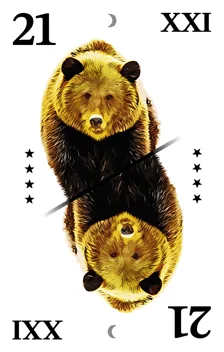
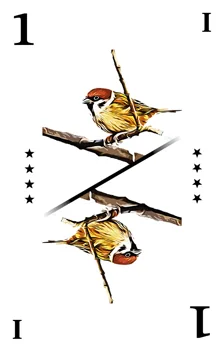
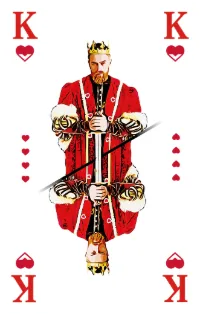
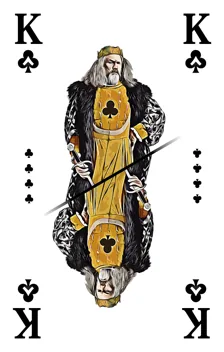
If the contract scores from the value of the tricks rather than the number of tricks, this is how you count Card Points (see Scoring in Core Concepts). The Declarer and the secret Partner push their piles together; in a solo, the three Defenders pool theirs. Then count your side’s cards in three steps: count the cards, divide by three and round to the nearest (your base count), then add the pips (your pip count). Kings, Queens, Cavaliers, Jacks and the Trull cards of the Alpine Tarok deck carry these pips. The two counts together are your side’s Card Points, out of the 70 Card Points in the deck.
How to count
The cards that leave the count
The pip carriers
 4
 4
 4
 4
 4
 1
Count the cards, then divide by three and round to the nearest whole number.
The count
- the base 25 cards, 3 8
- pips among them + 21
- of 70 in the deck 29
Then you score the hand. Only the Declarer’s side scores, and both partners score the same number of Victory Points. If the contract is won, that number is plus, and if the contract is lost, that number is minus. The Defenders score nothing. There are two exceptions: in the Dodge Round everyone scores their own result, and the Moon penalty is scored by the player who lost the Moon. You work out the number in three steps.
- Step one, the contract: Each player of the Declarer’s side scores the contract value.
- Step two, the distance: In the positive contracts, unless the contract says otherwise, the distance is plus if the contract was won and minus if it was lost: round the Card Points between the result and 35 Card Points to the nearest five, and score one Victory Point for every five Card Points.
- Step three, the bonuses: Every bonus is scored in the Declarer’s column too, as plus or as minus. It is plus when the Declarer’s side earns a bonus or the Defenders fail an announced one, and minus when the Defenders earn a bonus or the Declarer’s side fails an announced one.
The Skus round škis. Play to 200 Victory Points. The session traditionally ends with the Skus round, which begins with the next deal after a player reaches 200 Victory Points. That hand is dealt and played as usual, and at the end the players note who was dealt the Skus. When the deal next comes around to that player, their deal is the last hand. If the Skus was in the talon, that hand does not decide who deals last, and in the next hand the players note again who was dealt the Skus. The player with the highest total wins.
The Three-Player Game
Slovenian Tarok is also played by three players. These are the differences; everything else above applies.
With three players, these are the contracts, their talon cards and their Victory Points:
| Contract | Talon cards | VP |
|---|---|---|
| Dodge Round klop |
none | see below |
| Three trojka |
3 | 2 + distance |
| Two dvojka |
2 | 4 + distance |
| One enka |
1 | 6 + distance |
| Beggar berač |
none | 14 |
| Solo without solo brez |
none | 16 |
Deal. Each player gets 16 cards, in packets of eight. The talon has six cards as usual, and a hand has 16 tricks. The player left of the Dealer cuts or knocks.
P1
Forehand
P2
cuts
P3
Dealer
Everyone plays alone. the Declarer calls no King. Three, Two and One mean here that you play alone and take 3, 2 or 1 talon cards, and they take the place of the solos that take talon cards. Every contract keeps its Victory Points from the four-player contract table, and the bidding keeps the same standing rule. With three players Three is an ordinary bid that any player may open with. The Dodge Round is played when all three players pass.
- No King Ultimo (no called King to promise), and the Moon penalty stays personal: its loser scores minus 4 Victory Points. (In the traditional scoring this Moon penalty is 21 Victory Points in native numbers, not the usual 20; the Traditional Scoring Tables have the number.)
- Distances are often scored exactly rather than rounded to fives; agree before you start.
- Vogel frei (optional rule): if you are dealt the Pagat as your only Tarok, you may declare it free as a bird. The rules for following suit then do not apply to it: you may play it to any trick, and it wins that trick.
More for this game. Slovenian Tarok